
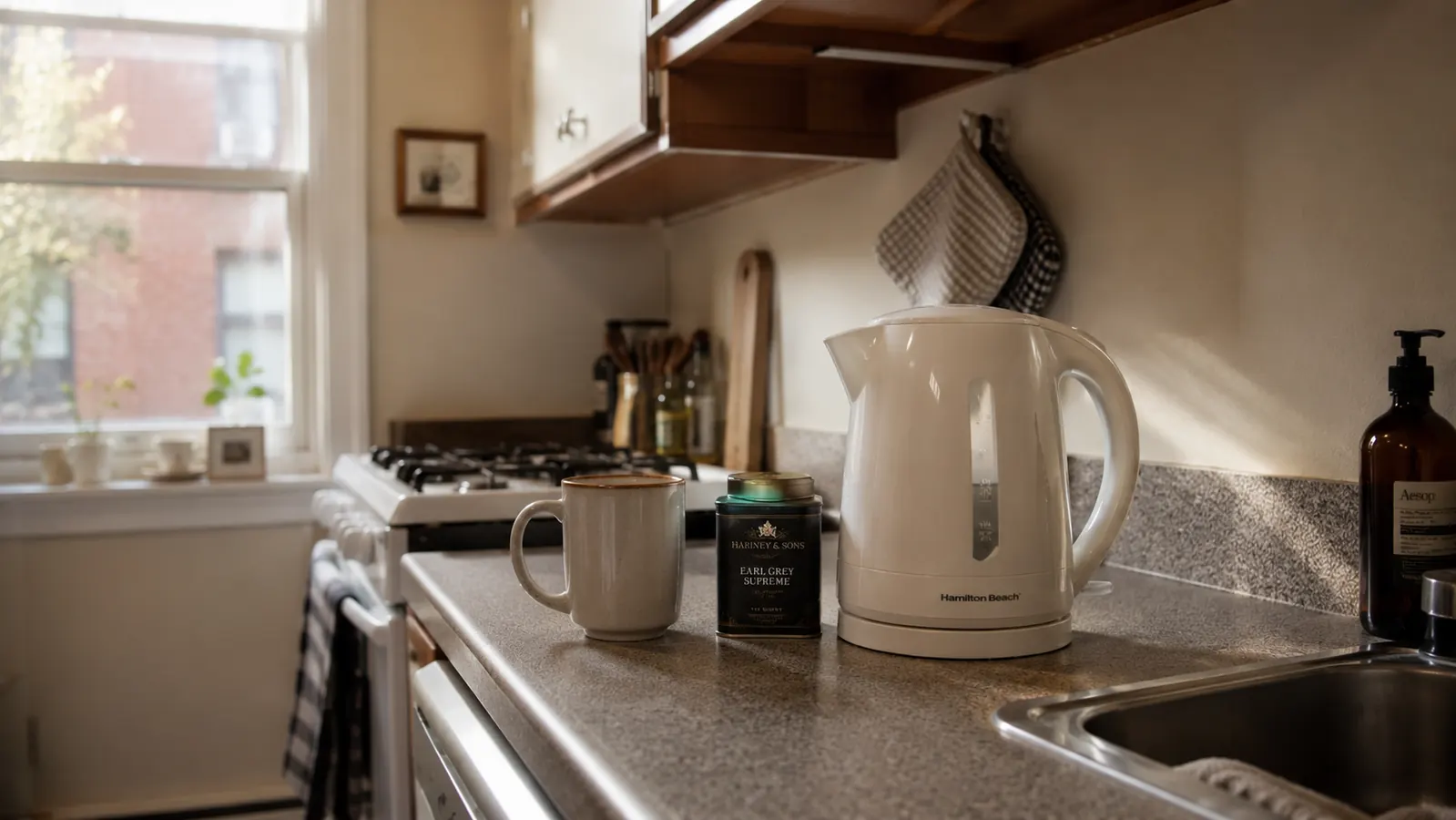
My kitchen is 58 square feet. I measured it once out of curiosity and immediately regretted knowing. The counter runs about six feet end to end, and that real estate has to hold a coffee maker, a cutting board, a dish rack, and whatever appliance I am currently testing. So when I bought the Hamilton Beach Electric Tea Kettle for cheap last June, I was not looking for a gadget. I was looking for something that could earn its six inches of counter space and hold up for the long run. Twelve months later, I still use it every single morning. This review is what I actually learned.
The Quick Verdict
A genuinely reliable, fast kettle that punches well above its price for small-kitchen cooks who boil water daily and want something that just works without fuss.
Amazon Check Today's Price →If your mornings feel slower than they should, a fast boil changes more than you'd expect.
The Hamilton Beach 1-liter kettle boils water in roughly 2 minutes, takes up almost no counter space, and costs less than two coffee-shop lattes. Check the current price on Amazon before it changes.
Amazon Check Today's Price on Amazon →How I've Used It
I am not a casual kettle user. I make pour-over coffee most mornings, a second cup of green tea mid-morning, and instant ramen or instant oatmeal on the nights I do not feel like cooking. That is four to five boil cycles a day on a busy week. Over twelve months, this kettle has probably cycled somewhere north of 1,200 times by my rough count. I live in a one-bedroom apartment in Phoenix. The tap water here is hard and slightly mineral-tasting, which I mention because it is relevant to how mineral scale behaves inside a kettle over time.
I did not treat this kettle gently or give it special care beyond a quarterly descale with a white vinegar soak. No filtered water, no daily wipe-down, no particular storage ritual. I wanted to know how it performs when you just use it like a normal person who has better things to think about. Most reviews I read before buying were first-impression takes written within a week of unboxing. That is not particularly useful when you are trying to figure out whether something will still be working correctly eighteen months from now.
I also compared it informally to the stovetop method I used before, and I have tried two other budget kettles over the past few years. My current benchmark for comparison in the same price tier is the Cuisinart CPK-17, which I have borrowed from a neighbor. I will note where the Hamilton Beach holds up and where it falls a little short.
Speed and Performance: Where It Genuinely Earns Its Place
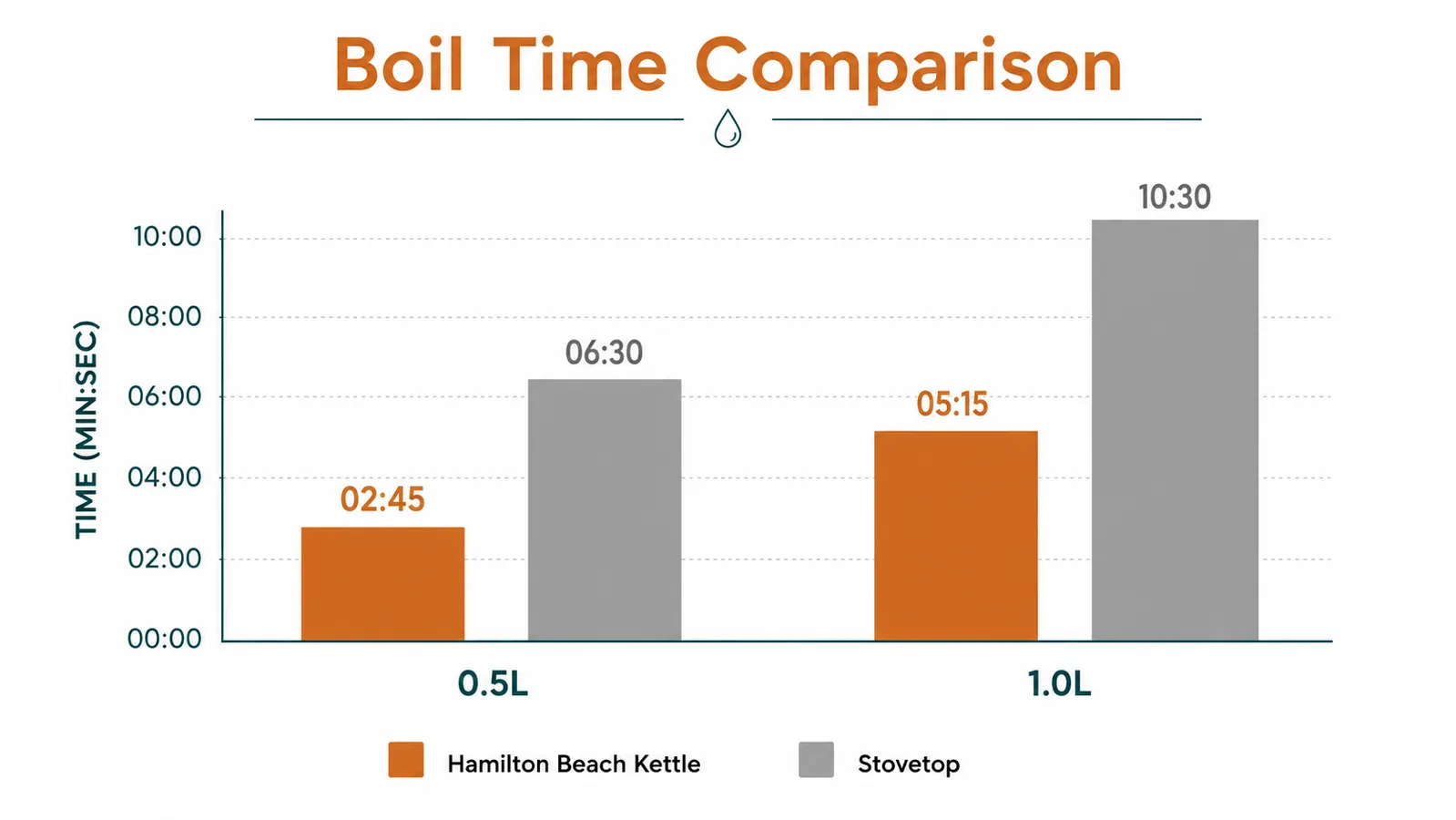
The 1500-watt element is the real story here. At half a liter of water, I am looking at roughly 90 seconds from cold tap to a full rolling boil. A full liter runs about two minutes and fifteen seconds in my testing. Compare that to my old gas stovetop setup in a medium saucepan, which was closer to five to six minutes for the same volume. That difference sounds small until you are standing in front of a stove at 6:45 in the morning before coffee has happened.
The auto shut-off is not a gimmick. It has never failed once in twelve months. The kettle clicks off reliably at the boil, which matters if you are the kind of person who fills the kettle, walks away to feed a cat or check a phone, and then forgets. No scorched element, no wasted electricity running after empty. For a small kitchen where leaving a burner on is a real safety concern, this is genuinely useful.
The boil-dry protection has also kicked in twice when I accidentally filled it below the minimum line and switched it on before noticing. Both times it shut itself off without drama. That kind of quiet competence is what you want from a budget appliance.
Build Quality After a Year: What Holds Up and What Shows Wear
The exterior is BPA-free plastic in a matte white finish. After twelve months it has some light surface scratches near the handle and a faint ring from where I always set it down on a slightly damp cloth. Nothing that affects function, but this is not an appliance that ages gracefully on the outside. If you want something that still looks pristine at the one-year mark, you are looking at a stainless kettle at a higher price point.
The lid clicks on firmly and has never come loose during pouring. The handle has stayed comfortable with zero wobble. The power base stays clean easily because it is a simple disc design with no grooves to trap grime. These are the details that matter when you are using something every single day.
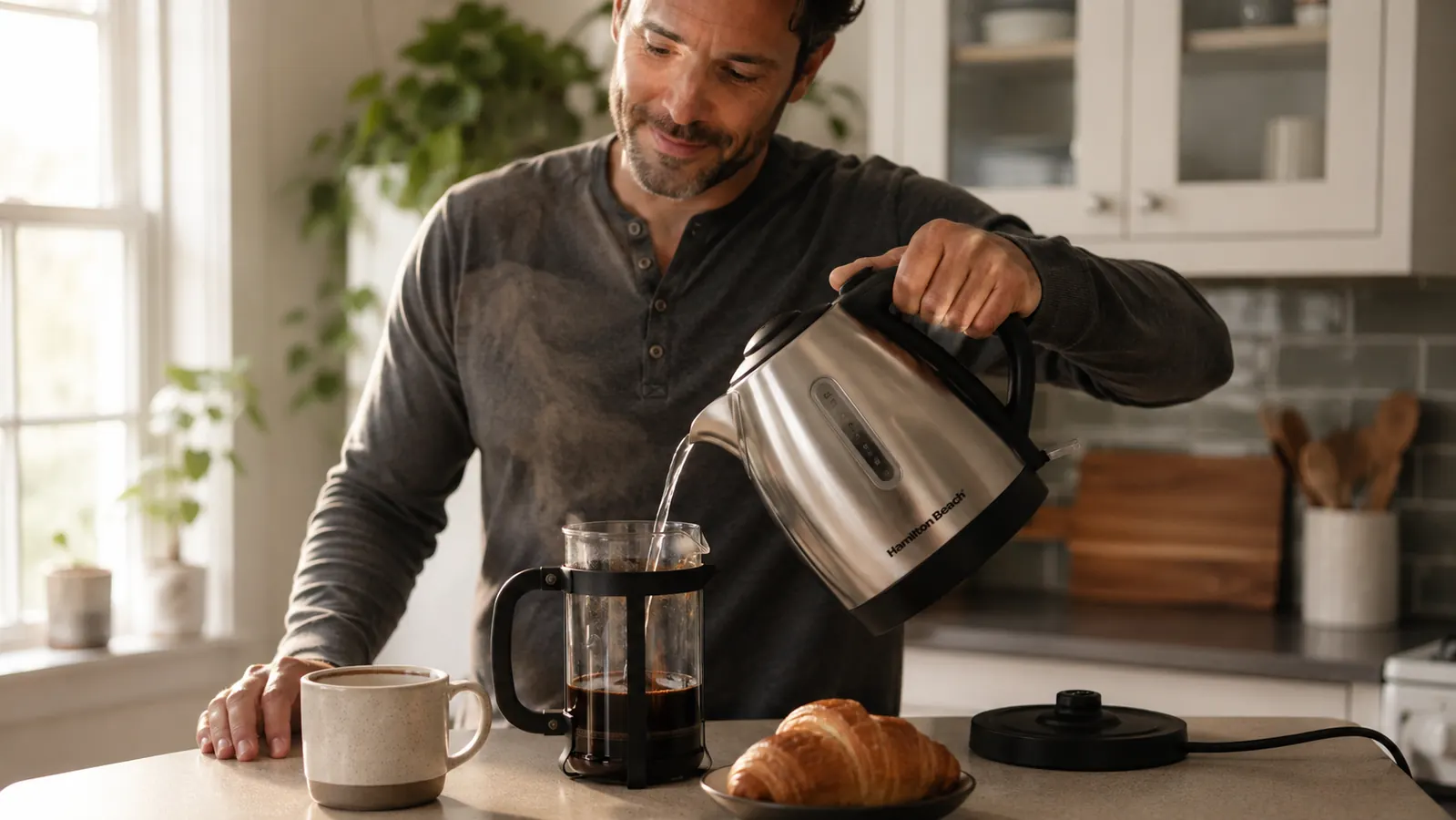
The spout pour is where I have a mild complaint. It flows fast, which is great for a French press but a little aggressive if you are trying to do a controlled pour-over. The stream is not as narrow or precise as you get with a gooseneck kettle. For everyday tea and instant coffee it is completely fine. For someone who cares a lot about pour-over flow rate, this is a real tradeoff worth thinking about before buying.
After 1,200 boil cycles, the auto shut-off has never missed once. That kind of quiet reliability is exactly what you want from a budget appliance.
The Scale Problem: What Happens in Hard-Water Areas
If you live somewhere with hard tap water, mineral buildup inside the kettle is not a question of if, it is a question of when and how much. At around the three-month mark I noticed white flaky deposits on the inside walls and starting to appear near the spout. I did a basic vinegar descale, soaking the interior with a 50/50 water-vinegar mix for about an hour, then rinsing thoroughly. It came out clean.
I have done this four times over the year. It adds maybe ten minutes of effort per quarter. Some people find scale annoying to manage. I find it a normal part of owning any kettle. The interior is accessible enough to clean without any special tools. If you want zero maintenance and perfect interior cleanliness, a stainless steel interior would serve you better, but you will pay noticeably more for it.
Noise and Everyday Versatility
One thing I did not expect to care about is noise, and yet it came up. I share a wall with a neighbor who works nights and sleeps until 9 AM. The Hamilton Beach kettle is noticeably quieter than a stovetop reaching a rolling boil. It heats with a low hum that builds and then clicks off. No rattling lid, no screaming whistle. In a shared-wall apartment or a studio where the kitchen is three feet from where someone is sleeping, this is a real practical advantage.
Beyond tea and coffee, I use this kettle more often than I expected for cooking. Boiling water for pasta is faster when you start the kettle, then transfer to the pot. Instant oatmeal, instant noodles, couscous, blanching vegetables, loosening a stuck jar lid with a quick pour, warming a baby bottle in a cup of hot water. In a tiny kitchen where your stove might only have two burners and both are often occupied, having a fast, independent water source that sits on the counter turns out to be more useful than it sounds on paper.

Counter Space Math in a Small Kitchen
The Hamilton Beach 1-liter model sits about seven inches tall and five inches across the base. On my counter, that is almost exactly the footprint of a large coffee mug. In a small kitchen where every inch is negotiated, that matters. The 1-liter capacity also means the full kettle is lightweight enough to pour with one hand comfortably, which is relevant in a galley kitchen where you are often reaching around other things.
If you regularly need to boil water for more than two people at once, you may find the 1-liter capacity limiting. I am cooking for one, occasionally two, and it has never felt restrictive. For a household of four making multiple rounds of tea, you would want the 1.7-liter version of this same kettle or a higher-capacity option.
How It Compares to the Cuisinart CPK-17
My neighbor has the Cuisinart CPK-17, which runs about four times the price. The Cuisinart has variable temperature settings, a stainless interior, a gooseneck pour spout, and a keep-warm function. These are genuinely useful features. But for someone who just needs fast boiling water and a reliable auto shut-off, paying four times more gets you things you may not actually use.
I tested both kettles side by side for a week. Boil times were similar for the same water volume. The Cuisinart poured more precisely and the stainless interior stayed cleaner. The Hamilton Beach was quieter at the boil in my informal testing. If you want a full side-by-side breakdown, I wrote a dedicated comparison piece that covers both models across seven different criteria.
The short version: if you want a daily driver for tea, instant coffee, oatmeal, and convenience, the Hamilton Beach is genuinely hard to beat for the price. If precise temperature control matters to you, look at the Cuisinart. You can read the full Hamilton Beach vs Cuisinart CPK-17 comparison if you want to go deeper.
What I Liked
- Boils a full liter in about 2 minutes 15 seconds, noticeably faster than stovetop
- Auto shut-off has never failed across 1,200-plus boil cycles in a year of testing
- Tiny footprint: about the space of a large coffee mug on your counter
- Lightweight at 1-liter capacity, easy to pour one-handed in a tight kitchen
- Boil-dry protection shuts down cleanly if you accidentally run it low
- Quieter than a stovetop boil, useful in apartments with shared walls or sleeping roommates
- Power base is a simple disc design with no grooves to trap grime
- Budget-friendly makes it easy to replace if something eventually goes wrong
Where It Falls Short
- Fast, wide-mouth spout is not precise enough for pour-over coffee technique
- Plastic exterior shows light scratching and wear marks after a year of daily use
- Hard water areas require quarterly descaling to keep buildup in check
- No temperature control: it boils water, full stop, no variable settings
- 1-liter capacity means two or more boil cycles for a household of four
Who This Is For
This kettle is built for the person in a studio apartment who makes tea or instant coffee every morning, wants the water ready fast, and does not have counter space to spare on a bulky appliance. It is also a natural fit for a dorm room, an RV, a tiny home, or a break room where simplicity matters more than features. If you have a small kitchen and you are still boiling water in a saucepan on the stove, this is genuinely one of the most useful budget upgrades you can make to your daily routine. The speed difference alone changes how unhurried the first ten minutes of your day feel. You also get the cooking versatility bonus: pasta water, instant meals, blanching, warming, all handled without tying up a burner. And if you want more reasons why an electric kettle belongs in every compact kitchen, the 10 reasons an electric kettle is the most underrated small kitchen tool piece covers everything in detail.
Who Should Skip It
If you make pour-over coffee as a serious daily ritual and care about pouring at a specific temperature with a controlled narrow stream, this kettle is going to frustrate you. The spout is too aggressive for precision work, and there are no temperature settings below a full boil. You want a gooseneck kettle with variable temperature control, which will cost more but serve that purpose correctly. Also, if your kitchen runs on particularly hard water and the idea of a quarterly vinegar soak sounds tedious, the mineral scale buildup inside this kettle will eventually annoy you. And if you regularly cook for a family of four, the 1-liter capacity means waiting on multiple back-to-back cycles, which erodes the speed advantage fairly quickly.
Twelve months of daily use and I would buy it again at the same price.
The Hamilton Beach 1-liter kettle is not the most feature-rich appliance on the market. It is fast, reliable, compact, and remarkably cheap. For a small kitchen where counter space and budget are both tight, that combination is hard to argue with. Check today's price on Amazon to see if it is still budget-friendly.
Amazon Check Today's Price on Amazon →