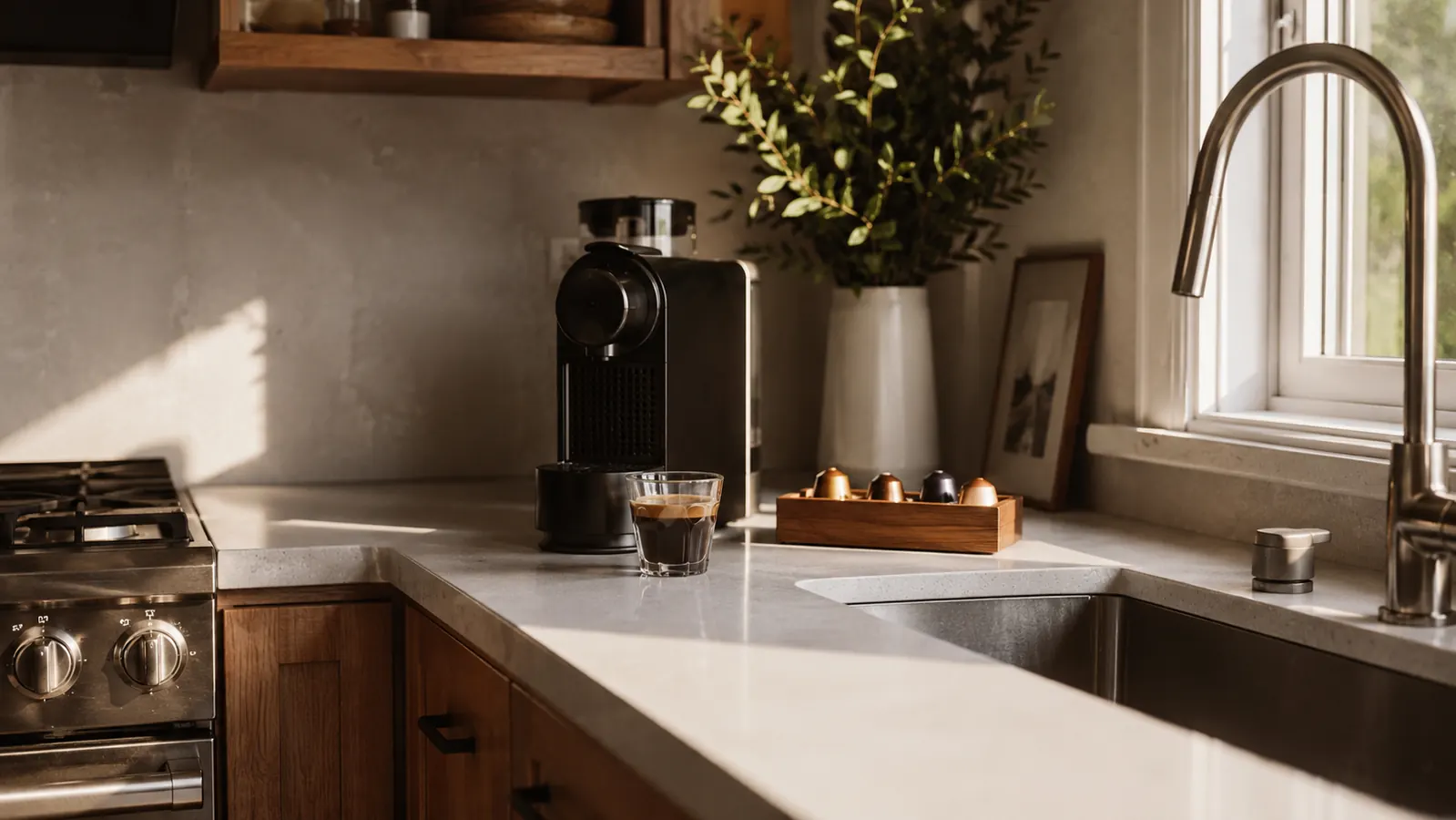
If you have been writing off a home espresso setup because your kitchen is tiny, I want to challenge that assumption right now. I live in a 520-square-foot apartment with a galley kitchen roughly the size of a hallway closet. For two years I told myself that a real espresso setup was for people with big kitchens and bigger budgets. Then I got the Nespresso Essenza Mini by De'Longhi and realized the whole thing fits in a corner about the size of a cereal box. The Nespresso Essenza Mini pulls a genuine 19-bar pressure shot, heats up in under 30 seconds, and takes up less counter space than a toaster. If you have been spending daily coffee shop money because making espresso at home sounded complicated, this guide is going to change that math fast.
This is not about a fancy permanent build-out. It is about carving out one small, functional corner of your kitchen so you can make a real espresso shot every morning without thinking twice. Follow these five steps and you will have a working espresso bar set up in under an hour.
Still paying daily latte prices for coffee you could pull in 30 seconds at home?
The Nespresso Essenza Mini is the smallest 19-bar espresso machine in the Nespresso Original Line. It fits on a single shelf, heats up in 25 seconds, and has over 6,000 Amazon ratings averaging 4.6 stars. Check today's price below.
Amazon Check Today's Price on Amazon →Step 1: Pick the Right Spot (Smaller Than You Think)
The Nespresso Essenza Mini measures just 4.7 inches wide, 12.8 inches deep, and 12.7 inches tall. That footprint is narrower than a standard dinner plate. Before you do anything else, find one spot in your kitchen that can hold something the size of a large coffee mug permanently, plus a few inches on either side. That is all you need. Most small kitchens have at least one dead corner, the end of a counter run, a narrow section beside the stove, a spot near the sink, that goes unused. That is your espresso bar location.
If your counter is truly maxed out, a floating shelf is your best friend. A single 12-inch-deep floating shelf mounted at counter height (about 36 inches from the floor) is enough to hold the Essenza Mini plus a small cup tray. IKEA's LACK shelf and similar budget options are inexpensive and hold 55 pounds. You do not need a renovation. You need one wall stud and a drill.
One thing to check before you commit to a spot: make sure there is an outlet within reach. The Essenza Mini's cord is about 4.5 feet long. If your only open outlet is across the kitchen, a short extension cord tucked behind the machine solves it cleanly. Avoid power strips flat on the counter if you can; they eat the space you are trying to save.

Step 2: Set Up the Nespresso Essenza Mini (Takes About 10 Minutes)
Out of the box, the Essenza Mini needs one initial rinse cycle before you pull your first shot. It sounds more involved than it is. Here is the actual process: fill the water tank (it holds 20 oz and slides out from the back), place a mug under the spout, press and hold the espresso button for three seconds to enter cleaning mode, and let it run about half a tank of water through. That is it. Total time: about eight minutes, mostly waiting.
The machine has two buttons. One is for espresso (1.35 oz), one is for lungo (3.7 oz). Press once to start, press again to stop early if you want a shorter pull. That is the entire learning curve. There is no steaming wand on the Essenza Mini, which is part of why it is so compact. If you want a milk-based drink like a flat white or a latte, you will need a separate milk frother, which I cover in step four.
A note on the water tank: 20 oz sounds small but it covers about two full espresso shots before you need to refill. If you make one drink a day, you will refill it every couple of mornings. I keep a small measuring cup next to my machine to fill the tank from the tap without picking up the whole unit and carrying it to the sink. Takes five seconds. One less friction point in the morning routine.
Step 3: Organize Your Capsules So They Are Always Ready
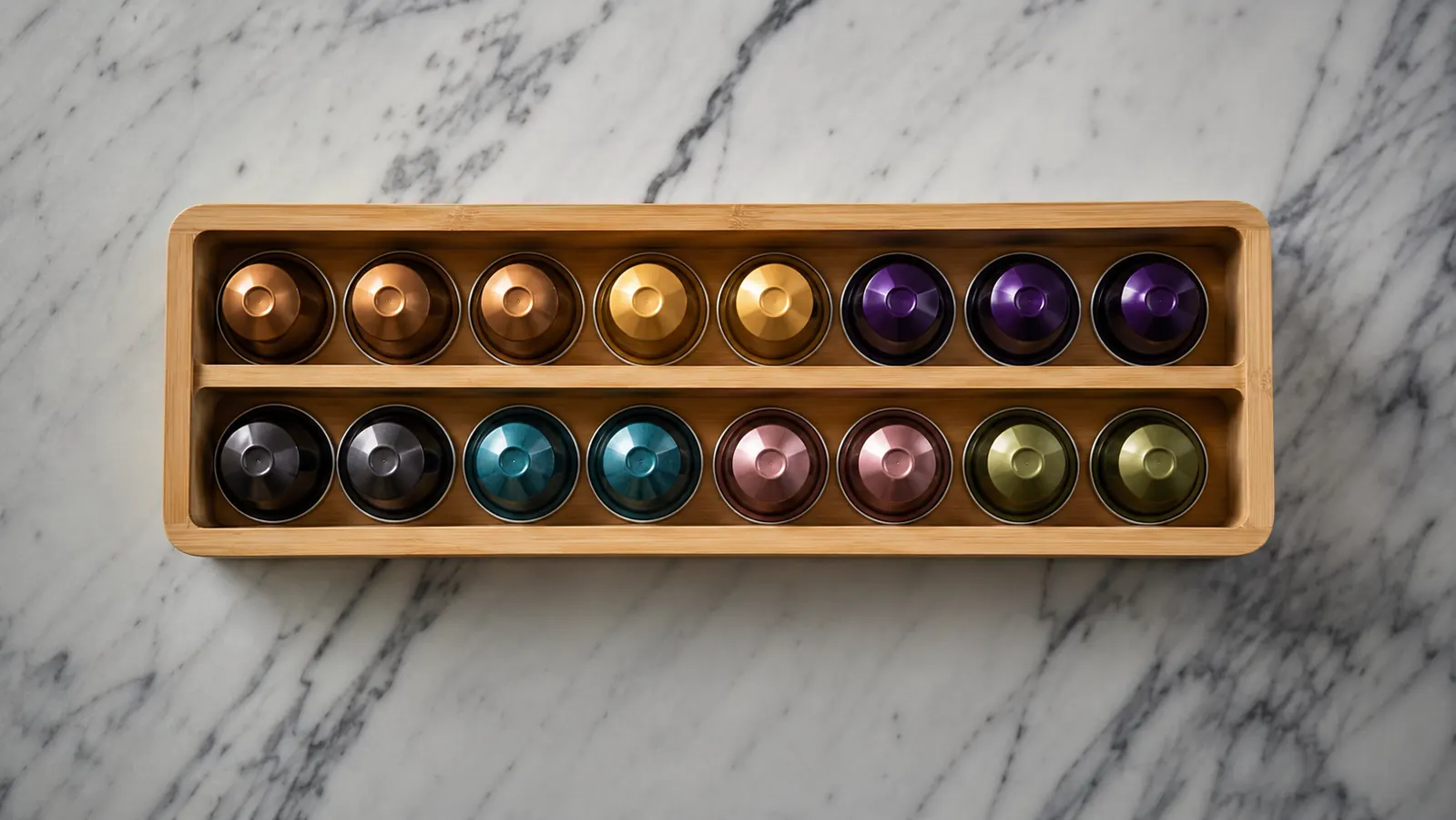
Nespresso Original Line capsules are what the Essenza Mini uses, and the selection is genuinely good. Nespresso offers around 30 single-origin and blend options across intensity levels from 4 (mild, smooth) to 13 (dark, intense). I keep about 20 capsules on hand at a time, which covers two to three weeks of daily use. The key to a clean espresso bar setup is having a storage solution that keeps capsules visible and accessible without sprawling across your counter.
Three storage options that work well in small kitchens: a small capsule carousel (holds 10 to 12 pods, rotates, sits next to the machine), a wall-mounted capsule strip (sticks inside a cabinet door and keeps pods completely off the counter), or a flat bamboo tray with pods laid out in a single row. I use the tray approach because I like seeing what I have. Whichever you choose, the goal is that you never have to dig through a drawer at 6 AM. If finding a capsule takes more than three seconds, your setup is working against you.
The used capsule bin is the thing most people forget to plan for. The Essenza Mini ejects spent capsules automatically into a small internal tray that holds about 10 to 11 pods. Once you factor in where that tray slides out, you will know exactly how much clearance you need on the right side of the machine.
Step 4: Add One Optional Accessory That Changes Everything
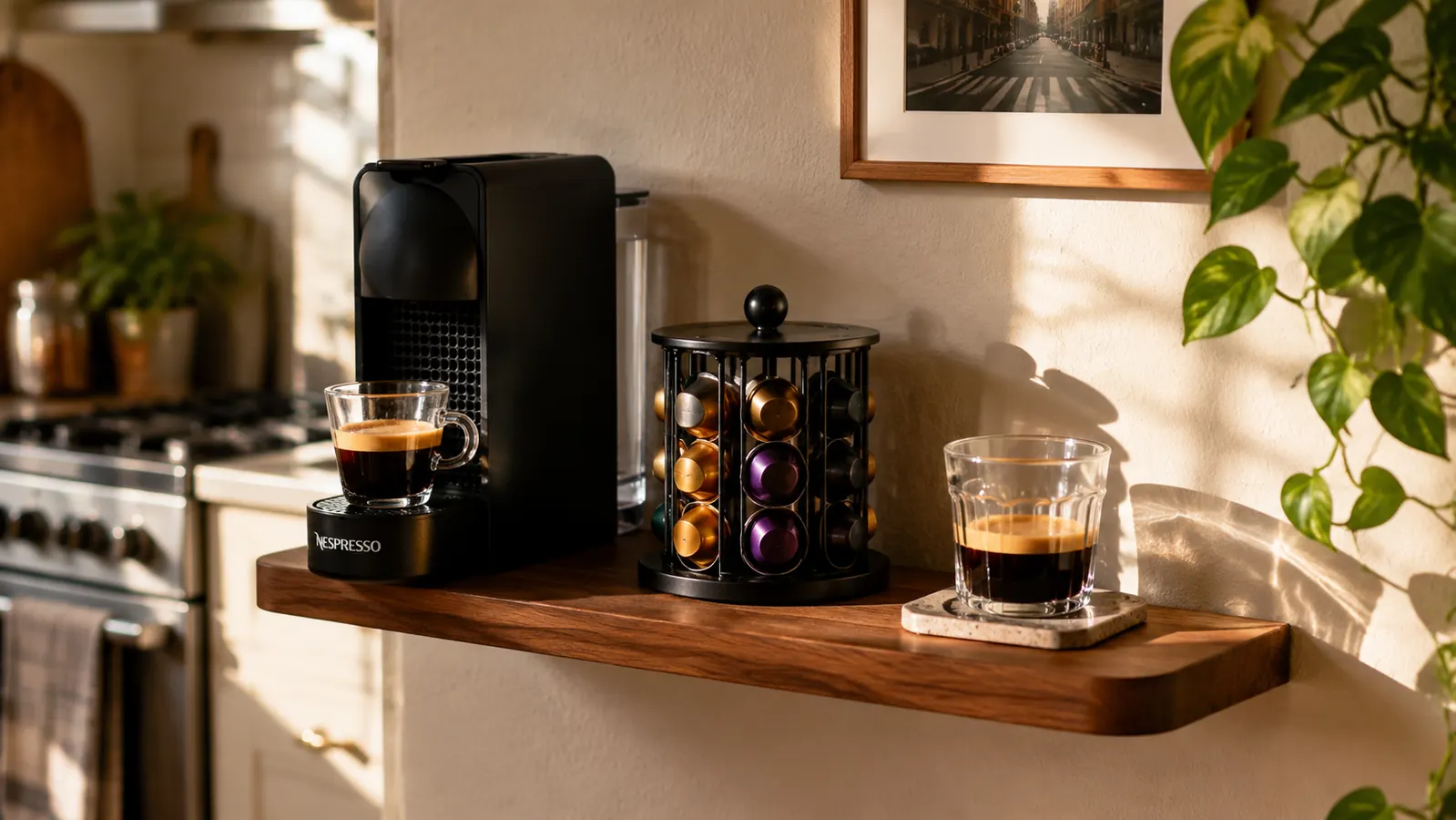
The Essenza Mini pulls a clean, crema-topped espresso shot on its own. But if you drink lattes, cappuccinos, or cortados, you will want a handheld milk frother. A basic battery-operated frother costs very little on Amazon and takes up the space of a pen. You heat your milk in a small mug in the microwave for 45 seconds, dip in the frother for 20 seconds, and you have steamed, frothy milk ready to pour over your espresso shot. Total added time: under two minutes.
This one accessory is what turns an espresso machine into a full café setup. A 6 oz to 8 oz microwave-safe ceramic mug works perfectly as a frothing vessel and doubles as your drink mug. You do not need a dedicated milk pitcher unless you want one. Keep it simple. If you want something a bit more polished, a small electric milk frother with a stand (the kind shaped like a small French press) takes up about the same footprint as a water glass and produces cafe-quality foam in about 60 seconds.
Step 5: Build the Habit So the Setup Actually Earns Its Space
A tool that is inconvenient to use will not get used. The whole point of a small-kitchen espresso bar is that it is faster and easier than leaving your apartment. If your setup requires more than four steps from rolling out of bed to holding a finished drink, it will not stick. The Essenza Mini makes this easy because the machine is always ready: no grinding, no tamping, no waiting for a pressure gauge to hit range. You drop in a capsule, press a button, and 25 seconds later you have a real espresso shot.
The habit-building piece is small but real: keep the machine on the counter, plugged in, with the water tank at least half full before you go to bed. Empty the used capsule tray every Sunday so it never overflows mid-week. Wipe the drip tray with a damp cloth twice a week. Run a descaling cycle every three months (Nespresso sells descaling solution and the machine will blink to tell you when it is time). Those four maintenance steps take less than 10 minutes a month combined. That is the whole upkeep load.
If you are consistent for two weeks, you will stop thinking of this as a process and start thinking of it as just how you make coffee. At that point, the coffee shop trip becomes the inconvenient option, not the easy one. That shift in default behavior is the real payoff of setting this up correctly from the start.
What Else Helps in a Small Kitchen Espresso Setup
A few additions that make a real difference without adding clutter. First, a small silicone drip mat or a thin rubber shelf liner under the machine protects your counter and absorbs vibration during brewing. Second, if you want to go totally counter-clear between uses, the Essenza Mini's cord is thin enough to tuck neatly and the machine itself weighs just over four pounds, light enough to slide into a lower cabinet in under five seconds. Some people do this every day. I leave mine out because it is the centerpiece of my morning routine, but the option is there if your counter situation demands it.
Third, consider a narrow rolling cart if you genuinely have zero counter space. A budget-friendly rolling kitchen cart with two shelves gives you an espresso bar that lives between the fridge and the wall and rolls out when you need it. You lose nothing permanent from your counter. This works especially well in dorm rooms and RVs where every square inch is negotiated separately. The Essenza Mini's compact dimensions mean it fits on almost any standard cart shelf without overhang.
One thing worth thinking through before you buy: the ongoing capsule cost. Nespresso Original Line capsules average in the mid to upper range per pod depending on the variety and where you buy them. If you drink one shot a day, that is roughly a moderate monthly capsule spend. Compare that to a daily coffeehouse latte habit and the math favors home espresso quickly. You can also buy Nespresso-compatible third-party capsules from brands like Peet's, Starbucks, and Lavazza for a slightly lower per-pod cost, and all of them work fine in the Essenza Mini. Having a realistic picture of the capsule cost before you start means no surprises once the machine is on your counter.
The biggest mistake small-kitchen coffee setups make is trying to fit too much gear into one corner. One machine, one storage solution for capsules, one mug ready to go. That is a complete setup. Add things only when you have proven you want them.
For more on how the Essenza Mini performs over the long haul, including what breaks down, what holds up, and whether the capsule cost makes sense over time, see the full long-term review linked below. And if you are trying to decide between the Essenza Mini and the Nespresso Vertuo Pop (a different capsule system with a different brew profile), the comparison breaks down exactly which one fits which kind of coffee drinker.
Ready to stop paying daily latte prices for a latte you could pull at home in 30 seconds?
The Nespresso Essenza Mini by De'Longhi is the machine I recommend to every small-kitchen coffee lover I know. Tiny footprint, real 19-bar espresso pressure, 25-second heat-up. Rated 4.6 stars by over 6,000 buyers on Amazon. Check today's price and see what color options are available.
Amazon Check Today's Price on Amazon →